Loksewa Tayari Mobile App
Nepal's top Lok Sewa exam preparation app - 100,000+ Downloads
Agency
Nep Tech Pal Pvt. Ltd.
Category
android
Type
android
Status
published
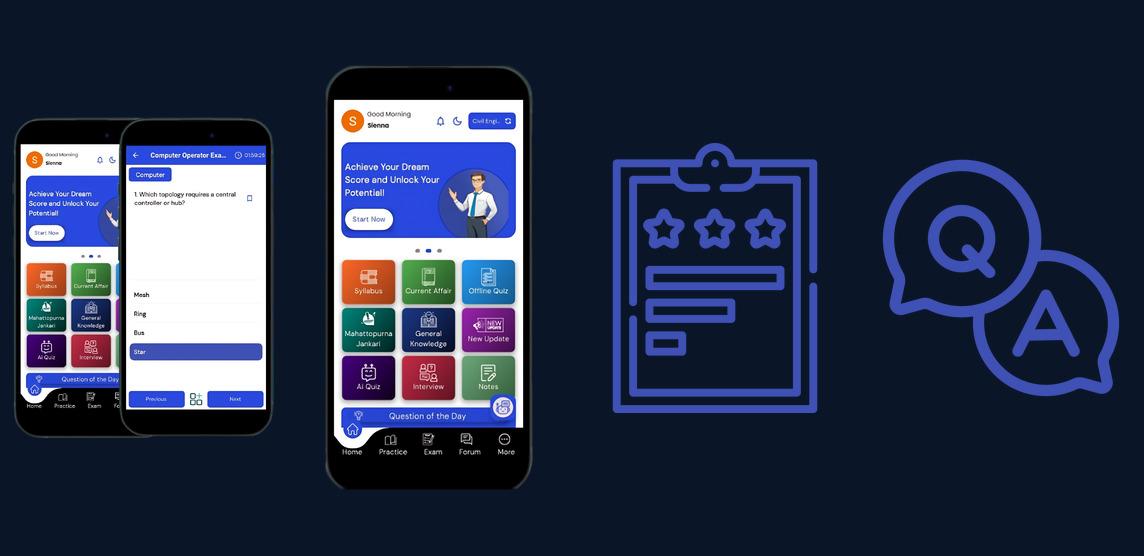
Key Features
Discover the powerful features that make this project stand out.
100,000+ Downloads
One of Nepal's most downloaded education apps with a 4.5★ rating on Google Play Store.
Offline Mode
Full offline access — study anywhere without internet including remote villages.
Daily Quiz Challenge
Gamified daily challenges keep users engaged and build consistent study habits.
Leaderboard
National leaderboard motivates competitive preparation among peers.
Push Notifications
Smart reminders for daily study sessions and exam date alerts.
Bookmark & Review
Bookmark difficult questions for focused review sessions.
From Challenge to Solution
Discover how we transformed challenges into innovative solutions.
The Challenge
The Challenge: Building an Education App That Works in Rural Nepal
Nepal's geography creates a digital divide that most app developers ignore. While Kathmandu Valley has reliable 4G and LTE, vast rural regions — where a large portion of civil service aspirants live — operate on spotty 2G/3G connections. An exam prep app that requires constant internet is fundamentally useless for a student in Rolpa, Bajhang, or Dolpa.
Beyond connectivity, there was the engagement problem. Most education apps suffer from one universal truth: users download them once, use them for a week, and abandon them. Duolingo famously solved this with streaks and gamification — their daily active user rate is extraordinary compared to traditional e-learning apps. We needed to solve the same problem for a much more specific, high-stakes use case: civil service exam preparation in Nepal.
The technical challenges were also significant:
- Offline data sync: 10,000+ questions need to be available offline without consuming excessive storage or bandwidth.
- Cross-device consistency: A user's progress on mobile should match what they see on the web platform.
- Performance on low-end devices: Many users have entry-level Android phones with 2GB RAM — the app must be fast and lightweight.
- Push notification reliability: Exam reminders are useless if they don't arrive. Firebase FCM must be configured correctly for Nepali carriers.
- Battery efficiency: Heavy background sync can drain batteries quickly — especially problematic on budget Android devices.
Ultimately, we were building for an audience that includes students who have never used a formal learning app before — the UX had to be simple, intuitive, and culturally familiar to a Nepali user.
Our Solution
Solution: Offline-First Architecture Meets Gamified Learning
We approached this like how Spotify handles offline music — download content in advance, sync when connected, and never let the user feel the absence of internet. The result is an app that feels just as fast and complete in a Himalayan village as it does in Kathmandu.
1. Delta-Sync Offline Architecture
The app uses a local SQLite database (via Drift, Flutter's SQL package) as the single source of truth for question banks, user progress, bookmarks, and mock exam history. On first install, the app downloads the full question bank in the background. Thereafter, only changed or new questions are synced — a delta-sync approach that keeps data usage minimal even on slow connections. Users can study for weeks without touching mobile data, and their progress syncs seamlessly when they reconnect.
2. Gamification Engine
Taking cues from Duolingo's proven retention mechanics, we built a daily challenge system with streaks, XP points, and a national leaderboard. Every day the app presents a new set of 10 questions — varied by topic — and rewards consistent participation with streak badges. Users who break a streak see a notification encouraging them to restart. This simple loop dramatically improves daily active user rates and builds the study habit that turns casual users into serious exam candidates.
3. Flutter for Near-Native Performance
Flutter's Skia rendering engine delivers 60fps animations even on budget Android devices with 2GB RAM. We carefully optimized the app's memory footprint — lazy loading question content, compressing images, and minimizing widget rebuilds. The app bundles at under 15MB (compressed), fast enough for users on limited storage plans to download without hesitation.
4. Firebase + Django Backend Integration
Firebase Cloud Messaging handles push notifications with near-100% delivery reliability on Nepali networks. Personalized notification timing (based on when each user typically opens the app) mirrors what LinkedIn does with their 'Your connection posted' alerts — sending at the moment most likely to drive engagement. The Django backend stores all long-term progress data and serves the web platform simultaneously, ensuring a unified experience across devices.
Technology Stack
The powerful technologies used to bring this project to life.
Django
Backend
PostgreSQL
Database
Firebase
DevOps
Dart
Mobile
Flutter
Mobile